Showing posts with label hockey. Show all posts

Tuesday, March 10, 2009

Starting Off On The Wrong Foot

For a few years now, we've been witness to Alex Ovechkin, all 6'2" and 212 lbs of him, zipping down the left wing and firing wrist shots past some of the best goalies in the world. The thing that makes him nearly impossible to stop is the way he shoots off the wrong foot. The picture on the right shows it perfectly: Ovie, on his right foot, driving through a shot. He drives his left leg back to create the same weight transfer as a correct-footed shot. Goalies hate this because it's unpredictable.


Now take Ovechkin's teammate, Alexander Semin. Semin is quite a bit smaller than Ovechkin, at 6', 180lbs. He's a different player (Ovie has 210 hits to Semin's 17), but he has something in common with his Russian friend: he possesses an amazingly hard wrist shot. How? It's that whole 'wrong foot' thing again, but I'd never noticed the extent of wrong-footedness until just recently.
As Semin starts his shot, he torques his body in such a way that while his torso is facing the net, his feet are aiming to the left. When he uncoils, his weight shift is incredibly pronounced. His legs are still pointed off to the left, forcing his torso and arms to accelerate to catch up. This also causes him to be off balance, resulting in a high left leg kick that acts as a counter balance. By using this technique, Semin is able to get more weight on his stick even though his wind up is shorter than a traditional wrist shot. This shot allows him to fire the puck in tight spaces and just after his famous toe-drag.



Tuesday, March 3, 2009

Caps' Needs

So, it's NHL trade deadline time. There are tons of rumors flying around involving multiple teams and players, some of which will probably prove to be true.

I've heard Niklas Backstrom (the Minnesota goalie, not the Caps center) and Chris Pronger are on the Caps' list, while Michael Nylander, Karl Alzner and other Caps are on other teams' radars.

I watch a team like Philadelphia beat up the Caps almost every time we play them. I also watch a low-level West-coast team like LA come in and beat the Caps to every loose puck. It seems that, outside Ovechkin and Bradley, the Caps are missing a strong physical aspect to their game. But it also seems, based on the lazy penalties and losing races to pucks, that the Caps also lack speed depth (again, line 1 is OK).

So I'll ask this: What do the Caps need, who do the Caps need, who should go, and who is untouchable?

Bad Semin, No Biscuit?

Just about every time I watch a Caps game or read a Caps blog, I tend to hear about how the Caps are undisciplined. They are currently 3rd in the league in minor penalties taken, most of which are obstruction penalties (hooking, tripping, holding, interference). Of all the Caps players, one player in particular usually gets the most criticism for ‘taking bad penalties’: Alexander Semin. Let's look at the stats.

In 45 games this season, Semin has taken 22 minor penalties, not including any coincidental penalties that didn’t lead to a power play situation (or 5 minute bongo-playing sessions). Most of Semin’s penalties are hooking (10) or tripping (7) infractions that result from attempting to take the puck from an opposing player. Of those penalties, 7 resulted in the other team scoring a power play goal and only 1 resulted in a game winning power play goal against.

Looking at particular situations, Semin has taken a penalty while on the power play 3 times, negating the man advantage for the Caps. While on the penalty kill, Semin has taken 4 penalties while a man down, resulting in a 5-on-3 situation against the Caps. The opposing team has only scored during 1 of these 5-on-3 situations.

Lastly, when Semin takes a non-coincidental minor penalty in a game, the Caps’ record is 14-3-2. When Semin scores a goal, the Caps are 15-4-1.

Clearly, Alexander Semin is far more important to the Caps when he’s on the ice than in the penalty box. But I don't think his penalties hurt the Caps as much as they're just frustrating to see.

Friday, February 13, 2009

Snapper

I pulled the following description from Wikipedia:
The snap shot is accomplished with a quick snap of the wrists while the puck rests in place. The difference between a snap shot and a wrist shot is that the hockey blade is accelerated towards the puck from a small distance behind it. This allows the player to flex the shaft on the ice and strike the puck at speed -- although not to the degree of a full slap shot…The stick is usually not lifted higher than the knee during the shot.

I tend to agree with everything about that statement, except the bold portion. In recent years, the term “half slap shot” has referred to a shot that resembles a slap shot, but with only half the wind-up (or the knee-high wind-up).

A snap shot is a far different animal. I like to use a face off dot as the representation of my wind-up space. With the puck in the center of the dot, my stick blade will stay within the diameter of the face-off dot and will get no higher than 4 or 5 inches from the ice.

You may be asking yourself “how do you generate any speed with that small a wind-up?” The answer is simpler than it sounds. 1) Speed is generated through the hips and lower torso. My weight is transferred from my back leg, driving my hip forward. Essentially, my lower body is rotating while my upper body is still. This generated torque between my lower body and torso. My upper body wants to rotate to catch up to my lower body, and accelerates to do so. With very little input (so far!) from my arms, my hands are already moving quickly. 2) I lower my shoulder and drive the toe of the stick into the ice. As stiff as they seem, all components of a stick flex when weight is applied. The stick blade flexes and flattens out for a split-second when it makes contact with the ice. The shaft of the stick also flexes, albeit not as severely as a slap shot will. The shaft and blade quickly snap back into position and helps accelerate the puck even more. The snap shot finishes with the same motion of a wrist shot; a snap of the wrists and a hard pull with the top hand, which turns the stick blade over.

A good, hard snap shot is a very hard shot for a goalie to pick up. It has no wind up, like with a wrist shot or slap shot, and it is as accurate as a wrist shot while being only slightly slower than a slap shot.

Wednesday, January 7, 2009

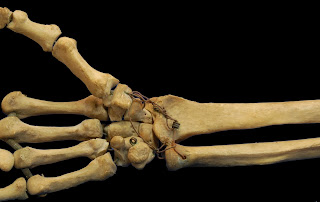
Biomechanics of the Wrist

Every joint in the human body is designed to flex in a certain way based on the structure of bones, tendons, ligaments and cartilage in the joint. Knees and elbows are designed to flex in one particular direction. The joints of hips and shoulders provide nearly full freedom of movement in all directions. The wrists and ankles allow for motions unique to the joints’ needs. Today we’ll talk about the wrist as it relates to hockey.


The wrist is a Condyloid joint and is constructed from several small bones that are surrounded by a capsule and strengthened by ligaments. This construction allows for three degrees of movement (Up and down, left and right, and axial rotation) of the joint.

Holding your arm out in front of you, palm down, rotate your hand as far as you can in one direction and the other without moving your shoulder. You should notice that rotation in one direction allows your palm to face up but does not allow for much more rotation past that (about 180 degrees of motion). In the other direction, your hand can move to a sideways position (about 90 degrees) before stopping. Attempting to rotate your wrist past these limits is not a natural motion and can end up causing some pain. These ‘hard stops’ define the limitations of the joint, or the ‘freedom of movement’.

In hockey, whenever you stick handle, pass, receive a pass or shoot a puck, you are rotating your wrists; sometimes slightly, sometimes severely and usually quite quickly. Holding your stick in the correct position allows your wrists to rotate freely without ever hitting a ‘hard stop’, decreasing the chance of causing wrist pain or injury and improving the accuracy and speed of the shot, pass, or stick handing move.

We’ll talk about the proper way to hold your stick in a bit. Just remember to stay within your body’s range of motion and you’ll find the proper technique based on how it feels to your body.

Tuesday, December 16, 2008

The Heart of Hockey

Hockey players are portrayed in the media as being violent and raw. The only time mainstream America hears about hockey is when someone does something aweful on the ice. It's quite unfair.
This story about the Chicago Blackhawks is one of hundreds of stories that arean't usually told but need to be.

"I've played for different teams in juniors and the pros," said the 26-year-old Sharp, from the Ontario hockey hotbed of Thunder Bay. "And you walk into every locker room and you become brothers. Maybe it's rare in pro sports, but it's not rare in hockey, I don't think. We're all in this together. It goes back to growing up in hockey. My older brother played, I played, and my parents made huge sacrifices to drive us everywhere we had to go. Everyone in this game knows how much family means."


I say it has nothing to do with being from Canada and everything to do with hockey. And with shaking your opponents' hands after you've battled them for 3 periods.

Monday, December 15, 2008

The Face Rule

I tend to develop 'rules' based on things I see out on the ice. Many of these rules build my hockey philosophy and I'm always adding new rules. Some rules are more important than others. I played in an adult-league game last night and something I saw supported one of those rules.

The rule is: If you insist on wearing only a half shield or no shield to protect your face and you flinch and cover your face every time the puck leaves the ice in your general vicinity, you should be wearing a full cage.

Half shields look cool, especially with the variety of tints and colors they now come in. But if you're wearing anything less than a full shield because it looks cool, you've missed the point.

Steve and I coach in half shields and Steve still plays in one. We used to coach in baseball caps! I switched back to a full cage after 5 stitches to the chin and I know Steve has been bloodied on at least one occasion. But in all the games we've played together, I've never seen Steve flinch because of a puck or a stick coming too close (and I'm pretty sure I never did). We still block shots and go into the corners with partial protection because we've learned how to tuck our chins and avoid damage.

This recent post by Third Man In further supports my theory (Warning: the picture is pretty ugly...no blood, but still bad).

Wear what you want to wear but if you're afraid of getting hurt, wear more protection.

Friday, December 12, 2008

Yes, we have ice in Maryland

We’re hockey coaches. We’re also talkers. We think it’s important to not only explain a drill but why it’s important and the concepts behind it. We also somehow manage talk about physics, psychology, anatomy and physiology. We talk about pro players and teams and why we like or dislike what they do.

In case you couldn’t tell, we sometimes get long-winded.

We’re also from Maryland, born and raised. We’re very passionate about the game we coach because those who taught us were equally as passionate. As hockey players in a non-hockey state, we feel it’s our responsibility to help the game grow and thrive.

The goal of this space is to talk about hockey at a level that practice time simply doesn’t allow. We’ll explain and demonstrate drills and concepts. We’ll talk about physics, psychology, anatomy and physiology. We’ll talk about our philosophies of the game. We’ll talk about the pros and our favorite players. We’ll probably even tell some stories.

Yes, there is ice in Maryland. And since there’s ice, we may as well play hockey.