
Hey everyone!
It's been a while since Ice In Maryland posted anything (probably because no one likes the blog name), so I recommend checking out http://jumpingtheglass.blogspot.com/ for my new blog. It deals with the Caps, the Gnu, coaching and a ton of other stories/useful information.
Have fun!
-Kevin
Monday, December 14, 2009

Tuesday, March 10, 2009
Starting Off On The Wrong Foot
 For a few years now, we've been witness to Alex Ovechkin, all 6'2" and 212 lbs of him, zipping down the left wing and firing wrist shots past some of the best goalies in the world. The thing that makes him nearly impossible to stop is the way he shoots off the wrong foot. The picture on the right shows it perfectly: Ovie, on his right foot, driving through a shot. He drives his left leg back to create the same weight transfer as a correct-footed shot. Goalies hate this because it's unpredictable.
 Now take Ovechkin's teammate, Alexander Semin. Semin is quite a bit smaller than Ovechkin, at 6', 180lbs. He's a different player (Ovie has 210 hits to Semin's 17), but he has something in common with his Russian friend: he possesses an amazingly hard wrist shot. How? It's that whole 'wrong foot' thing again, but I'd never noticed the extent of wrong-footedness until just recently.
 As Semin starts his shot, he torques his body in such a way that while his torso is facing the net, his feet are aiming to the left. When he uncoils, his weight shift is incredibly pronounced.
  His legs are still pointed off to the left, forcing his torso and arms to accelerate to catch up. This also causes him to be off balance, resulting in a high left leg kick that acts as a counter balance. By using this technique, Semin is able to get more weight on his stick even though his wind up is shorter than a traditional wrist shot. This shot allows him to fire the puck in tight spaces and just after his famous toe-drag.

Tuesday, March 3, 2009
Caps' Needs
So, it's NHL trade deadline time. There are tons of rumors flying around involving multiple teams and players, some of which will probably prove to be true.
I've heard Niklas Backstrom (the Minnesota goalie, not the Caps center) and Chris Pronger are on the Caps' list, while Michael Nylander, Karl Alzner and other Caps are on other teams' radars.
I watch a team like Philadelphia beat up the Caps almost every time we play them. I also watch a low-level West-coast team like LA come in and beat the Caps to every loose puck. It seems that, outside Ovechkin and Bradley, the Caps are missing a strong physical aspect to their game. But it also seems, based on the lazy penalties and losing races to pucks, that the Caps also lack speed depth (again, line 1 is OK).
So I'll ask this: What do the Caps need, who do the Caps need, who should go, and who is untouchable?
I've heard Niklas Backstrom (the Minnesota goalie, not the Caps center) and Chris Pronger are on the Caps' list, while Michael Nylander, Karl Alzner and other Caps are on other teams' radars.
I watch a team like Philadelphia beat up the Caps almost every time we play them. I also watch a low-level West-coast team like LA come in and beat the Caps to every loose puck. It seems that, outside Ovechkin and Bradley, the Caps are missing a strong physical aspect to their game. But it also seems, based on the lazy penalties and losing races to pucks, that the Caps also lack speed depth (again, line 1 is OK).
So I'll ask this: What do the Caps need, who do the Caps need, who should go, and who is untouchable?
Bad Semin, No Biscuit?
Just about every time I watch a Caps game or read a Caps blog, I tend to hear about how the Caps are undisciplined. They are currently 3rd in the league in minor penalties taken, most of which are obstruction penalties (hooking, tripping, holding, interference). Of all the Caps players, one player in particular usually gets the most criticism for ‘taking bad penalties’: Alexander Semin. Let's look at the stats.
In 45 games this season, Semin has taken 22 minor penalties, not including any coincidental penalties that didn’t lead to a power play situation (or 5 minute bongo-playing sessions). Most of Semin’s penalties are hooking (10) or tripping (7) infractions that result from attempting to take the puck from an opposing player. Of those penalties, 7 resulted in the other team scoring a power play goal and only 1 resulted in a game winning power play goal against.
Looking at particular situations, Semin has taken a penalty while on the power play 3 times, negating the man advantage for the Caps. While on the penalty kill, Semin has taken 4 penalties while a man down, resulting in a 5-on-3 situation against the Caps. The opposing team has only scored during 1 of these 5-on-3 situations.
Lastly, when Semin takes a non-coincidental minor penalty in a game, the Caps’ record is 14-3-2. When Semin scores a goal, the Caps are 15-4-1.
Clearly, Alexander Semin is far more important to the Caps when he’s on the ice than in the penalty box. But I don't think his penalties hurt the Caps as much as they're just frustrating to see.
In 45 games this season, Semin has taken 22 minor penalties, not including any coincidental penalties that didn’t lead to a power play situation (or 5 minute bongo-playing sessions). Most of Semin’s penalties are hooking (10) or tripping (7) infractions that result from attempting to take the puck from an opposing player. Of those penalties, 7 resulted in the other team scoring a power play goal and only 1 resulted in a game winning power play goal against.
Looking at particular situations, Semin has taken a penalty while on the power play 3 times, negating the man advantage for the Caps. While on the penalty kill, Semin has taken 4 penalties while a man down, resulting in a 5-on-3 situation against the Caps. The opposing team has only scored during 1 of these 5-on-3 situations.
Lastly, when Semin takes a non-coincidental minor penalty in a game, the Caps’ record is 14-3-2. When Semin scores a goal, the Caps are 15-4-1.
Clearly, Alexander Semin is far more important to the Caps when he’s on the ice than in the penalty box. But I don't think his penalties hurt the Caps as much as they're just frustrating to see.
NHL
With the NHL trade deadline arriving in a few days, I've decided I'm going to talk about the big leagues for a while. Pardon my infatuation with all things Washington Capitals for a few days.
Friday, February 13, 2009
Biomechanics
Biomechanics is the application of mechanical principles to living organisms.
I consider myself a bit of a geek when it comes to mechanical systems. I love figuring out how things work and why and I tend to apply that inquisitive part of me in analyzing all things sports related. I try to break down simple motions into even simpler motions to answer questions about the motion.
In hockey, I'm constantly deconstructing the strides, shots, turns and passes of myself and others in order to correct flaws or simply get better. As I haven't been able to shoot a puck over 100 mph, clearly I have some more work to do.

I recently read an article about a baseball pitcher, 2008 Cy Young Award winner Tim Lincecum. Lincecum, you see is only 5'10" tall and weighs only 175 pounds, but is somehow able to throw a baseball 97 mph. It's not a fluke though. Lincecum has a unique delivery; he drives hard off his back leg and severely torques his body, allowing him to accelerate his arm without putting stress on his shoulder.
The article gets pretty deep into the study of sports biomechanics and, while it deals entirely with baseball pitchers, much of the science can be directly related to hockey. It's a fascinating read...I highly recommend it.
Then again, I geek out over this stuff.
Snapper
I pulled the following description from Wikipedia:
I tend to agree with everything about that statement, except the bold portion. In recent years, the term “half slap shot” has referred to a shot that resembles a slap shot, but with only half the wind-up (or the knee-high wind-up).
A snap shot is a far different animal. I like to use a face off dot as the representation of my wind-up space. With the puck in the center of the dot, my stick blade will stay within the diameter of the face-off dot and will get no higher than 4 or 5 inches from the ice.
You may be asking yourself “how do you generate any speed with that small a wind-up?” The answer is simpler than it sounds. 1) Speed is generated through the hips and lower torso. My weight is transferred from my back leg, driving my hip forward. Essentially, my lower body is rotating while my upper body is still. This generated torque between my lower body and torso. My upper body wants to rotate to catch up to my lower body, and accelerates to do so. With very little input (so far!) from my arms, my hands are already moving quickly. 2) I lower my shoulder and drive the toe of the stick into the ice. As stiff as they seem, all components of a stick flex when weight is applied. The stick blade flexes and flattens out for a split-second when it makes contact with the ice. The shaft of the stick also flexes, albeit not as severely as a slap shot will. The shaft and blade quickly snap back into position and helps accelerate the puck even more. The snap shot finishes with the same motion of a wrist shot; a snap of the wrists and a hard pull with the top hand, which turns the stick blade over.
A good, hard snap shot is a very hard shot for a goalie to pick up. It has no wind up, like with a wrist shot or slap shot, and it is as accurate as a wrist shot while being only slightly slower than a slap shot.
The snap shot is accomplished with a quick snap of the wrists while the puck rests in place. The difference between a snap shot and a wrist shot is that the hockey blade is accelerated towards the puck from a small distance behind it. This allows the player to flex the shaft on the ice and strike the puck at speed -- although not to the degree of a full slap shot…The stick is usually not lifted higher than the knee during the shot.
I tend to agree with everything about that statement, except the bold portion. In recent years, the term “half slap shot” has referred to a shot that resembles a slap shot, but with only half the wind-up (or the knee-high wind-up).
A snap shot is a far different animal. I like to use a face off dot as the representation of my wind-up space. With the puck in the center of the dot, my stick blade will stay within the diameter of the face-off dot and will get no higher than 4 or 5 inches from the ice.
You may be asking yourself “how do you generate any speed with that small a wind-up?” The answer is simpler than it sounds. 1) Speed is generated through the hips and lower torso. My weight is transferred from my back leg, driving my hip forward. Essentially, my lower body is rotating while my upper body is still. This generated torque between my lower body and torso. My upper body wants to rotate to catch up to my lower body, and accelerates to do so. With very little input (so far!) from my arms, my hands are already moving quickly. 2) I lower my shoulder and drive the toe of the stick into the ice. As stiff as they seem, all components of a stick flex when weight is applied. The stick blade flexes and flattens out for a split-second when it makes contact with the ice. The shaft of the stick also flexes, albeit not as severely as a slap shot will. The shaft and blade quickly snap back into position and helps accelerate the puck even more. The snap shot finishes with the same motion of a wrist shot; a snap of the wrists and a hard pull with the top hand, which turns the stick blade over.
A good, hard snap shot is a very hard shot for a goalie to pick up. It has no wind up, like with a wrist shot or slap shot, and it is as accurate as a wrist shot while being only slightly slower than a slap shot.
Wednesday, February 11, 2009
Big Heart Ted
Ever since Ted Leonsis, owner of the Washington Capitals, bought the team, he's been a passionate voice for hockey in the DC area. I genuinely believe that he loves hockey and his team and wants it to succeed.
That said, the man is also a terrific human being, as seen in this first-hand account by Tarik El-Bashir of the Washington Post.
If you see him walking the halls the next time you take in a Caps game, shake his hand for this rather than for bringing back good hockey to the area.
That said, the man is also a terrific human being, as seen in this first-hand account by Tarik El-Bashir of the Washington Post.
If you see him walking the halls the next time you take in a Caps game, shake his hand for this rather than for bringing back good hockey to the area.
Monday, February 9, 2009
Constructive Criticism
I was sent this article by a friend and fellow hockey player. The article is entitled "Unskilled and Unaware of It: How Difficulties in Recognizing One's Own Incompetence Lead to Inflated Self-Assessments" and it is an incredibly interesting read. Here's a quick excerpt from the abstract:
In coaching, we're constantly finding ourselves faced with the opportunity to provide constructive criticism to a student in order to increase the player's skill set. Often, we see that advice abandoned because the player 'already knows how to' perform the particular skill.
Constructive criticism can come in many forms, from a simple 'try it this way' to a red 'X' on a test. Both provide you with feedback on your actions or knowledge of a subject and you can learn a lot from both, IF you're open to the criticism.
A 'wrong' often teaches you more than a 'right', but you first need to be able to acknowledge the wrong and ask 'why?' and 'how do I get to right?' That's where learning truly begins.
People tend to hold overly favorable views of their abilities in many social and intellectual domains. The authors suggest that this overestimation occurs, in part, because people who are unskilled in these domains suffer a dual burden: Not only do these people reach erroneous conclusions and make unfortunate choices, but their incompetence robs them of the metacognitive ability to realize it. Across 4 studies, the authors found that participants scoring in the bottom quartile on tests of humor, grammar, and logic grossly overestimated their test performance and ability.
In coaching, we're constantly finding ourselves faced with the opportunity to provide constructive criticism to a student in order to increase the player's skill set. Often, we see that advice abandoned because the player 'already knows how to' perform the particular skill.
Constructive criticism can come in many forms, from a simple 'try it this way' to a red 'X' on a test. Both provide you with feedback on your actions or knowledge of a subject and you can learn a lot from both, IF you're open to the criticism.
A 'wrong' often teaches you more than a 'right', but you first need to be able to acknowledge the wrong and ask 'why?' and 'how do I get to right?' That's where learning truly begins.
Thursday, January 15, 2009
Fisticuffs
I just thought I'd link to an interesting article on fighting. This one particular quote from Wendel Clark, former captain of the Toronto Maple Leafs, pretty much sums up my opinion on the issue:
"Look, I'm not going to say I'm against it. I played that way. I think it's part of the game at the pro level. What I am concerned about is the amount of fighting going on in minor hockey. There are only two levels where it is allowed and there are specific rules for it - the pros and junior. Yet at the bantam and midget levels, not just at AAA but AA and A too, the amount of fights are going up. It is not part of the game there. There are no rules. You fight, you're kicked out. Yet it's increasing. Who is condoning this for our kids? Coaches, parents, whoever it is, it has to stop.
Fighting in the pros is one thing. They are adults. They are professionals. They are doing it for a living. But kids? I know in my case, I didn't have my first fight until junior. No one starts out wanting to be a fighter. They all want to be finesse guys, the next Sidney Crosby. Like I said, there is room for it in the pros in my opinion, but what's going on with the kids concerned me.”
Thursday, January 8, 2009
What's in a Name?
We've gotten a lot of feedback about the blog so far, but the most commonly asked question is 'What's with the name? It's bad.' Is it? Tell us what you think!
Wednesday, January 7, 2009
Biomechanics of the Wrist
Every joint in the human body is designed to flex in a certain way based on the structure of bones, tendons, ligaments and cartilage in the joint. Knees and elbows are designed to flex in one particular direction. The joints of hips and shoulders provide nearly full freedom of movement in all directions. The wrists and ankles allow for motions unique to the joints’ needs. Today we’ll talk about the wrist as it relates to hockey.
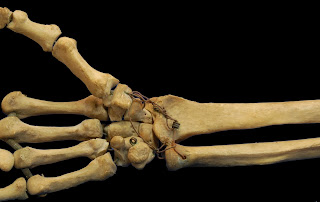
The wrist is a Condyloid joint and is constructed from several small bones that are surrounded by a capsule and strengthened by ligaments. This construction allows for three degrees of movement (Up and down, left and right, and axial rotation) of the joint.
Holding your arm out in front of you, palm down, rotate your hand as far as you can in one direction and the other without moving your shoulder. You should notice that rotation in one direction allows your palm to face up but does not allow for much more rotation past that (about 180 degrees of motion). In the other direction, your hand can move to a sideways position (about 90 degrees) before stopping. Attempting to rotate your wrist past these limits is not a natural motion and can end up causing some pain. These ‘hard stops’ define the limitations of the joint, or the ‘freedom of movement’.
In hockey, whenever you stick handle, pass, receive a pass or shoot a puck, you are rotating your wrists; sometimes slightly, sometimes severely and usually quite quickly. Holding your stick in the correct position allows your wrists to rotate freely without ever hitting a ‘hard stop’, decreasing the chance of causing wrist pain or injury and improving the accuracy and speed of the shot, pass, or stick handing move.
We’ll talk about the proper way to hold your stick in a bit. Just remember to stay within your body’s range of motion and you’ll find the proper technique based on how it feels to your body.
Monday, January 5, 2009
Puck and Stick
Many coaches throw the term ‘stick handling’ around as though it happens every time a puck touches a stick blade. Skating unopposed up the ice, turning to go around an opponent, and making a deke on a goalie seem to always be called ‘stick handling’. I prefer to distinguish between these movements.
I find the term ‘puck control’ is a more accurate description of what a player does with the puck when they’re not around an opponent. The goal is simply to maintain control of the puck; to keep it in a position that allows you to move it as you like and eventually make a pass, take a shot, or ‘stick handle’. There isn’t a lot of fancy stick movement while controlling the puck, as excess movement creates the opportunity to lose control and turn the puck over. Sometimes good ‘puck control’ is carrying the puck up ice or even just pushing it out on front of you in a controlled manner. Everyone knows you have the puck, but no one is close enough to make an effort to steal it from you.
Simply skating around with a puck is a good ‘puck control’ drill. Maintaining good puck control can also entail the use of the skates to kick up and pucks that are lost in the feet. Any way to maintain control of the puck counts.
‘Stick handling’ comes into play once you enter high-traffic areas. At this point, you’re close enough to opponents that they can attempt to steal the puck or knock the puck away from you. ‘Stick handling’ moves are used to confuse the opponent and get him reaching for the puck. Continuously moving the puck makes this effort harder for the opponent.
When in close on a goalie, ‘stick handling’ comes up again. A simple deke is a 'stick handling' move intended to confuse the goalie and cause him to make the first move, or ‘commit’. Once committed, a goalie’s options are very limited and the chances for a goal increase.
‘Stick handling’ involves creativity and improvisation. Your actions depend on those of another skater or goalie and are constantly changing based on those reactions. A good ‘stick handling’ move is often unexpected or done quickly enough that an opponent cannot react in time. Trying a new ‘move’ in practice often leads to its use in a game situation.
Just remember, it’s all about controlling the puck. You can’t score without it and neither can the other team.
I find the term ‘puck control’ is a more accurate description of what a player does with the puck when they’re not around an opponent. The goal is simply to maintain control of the puck; to keep it in a position that allows you to move it as you like and eventually make a pass, take a shot, or ‘stick handle’. There isn’t a lot of fancy stick movement while controlling the puck, as excess movement creates the opportunity to lose control and turn the puck over. Sometimes good ‘puck control’ is carrying the puck up ice or even just pushing it out on front of you in a controlled manner. Everyone knows you have the puck, but no one is close enough to make an effort to steal it from you.
Simply skating around with a puck is a good ‘puck control’ drill. Maintaining good puck control can also entail the use of the skates to kick up and pucks that are lost in the feet. Any way to maintain control of the puck counts.
‘Stick handling’ comes into play once you enter high-traffic areas. At this point, you’re close enough to opponents that they can attempt to steal the puck or knock the puck away from you. ‘Stick handling’ moves are used to confuse the opponent and get him reaching for the puck. Continuously moving the puck makes this effort harder for the opponent.
When in close on a goalie, ‘stick handling’ comes up again. A simple deke is a 'stick handling' move intended to confuse the goalie and cause him to make the first move, or ‘commit’. Once committed, a goalie’s options are very limited and the chances for a goal increase.
‘Stick handling’ involves creativity and improvisation. Your actions depend on those of another skater or goalie and are constantly changing based on those reactions. A good ‘stick handling’ move is often unexpected or done quickly enough that an opponent cannot react in time. Trying a new ‘move’ in practice often leads to its use in a game situation.
Just remember, it’s all about controlling the puck. You can’t score without it and neither can the other team.
Friday, December 19, 2008
Hockey Science
By day, I’m not a hockey player or coach, I’m a mechanical engineer. Some people assume I got my engineering degree because I’m super smart. Honestly, I’m not. I made sacrifices and spent a lot of late nights studying and doing homework. Engineering involves a lot of math and physics, but engineering is mostly just a way of thinking. I call it "Engineering Common Sense".
When I explain a drill or a concept, I often get quite technical. This is because I usually spend some time asking myself “why does this work?” or “why do it this way?” It interests me, and I like to think that in this Discover Channel time, it might interest others. I like to know the science behind what we do on the ice; whether it has to do with why skates glide or how a slap shot works. I also think about equipment and why some designer or engineer created a particular piece of equipment a certain way. Was it for protection, weight savings, or is it purely for looks?
 The basic components of a ‘hockey equipment set’ have been around for over 100 years. Shoulder pads, elbow pads, gloves, shin pads, pants, skates and helmets are the staples of hockey. But their appearance, construction and functionality have all dramatically changed over the years.
When I explain a drill or a concept, I often get quite technical. This is because I usually spend some time asking myself “why does this work?” or “why do it this way?” It interests me, and I like to think that in this Discover Channel time, it might interest others. I like to know the science behind what we do on the ice; whether it has to do with why skates glide or how a slap shot works. I also think about equipment and why some designer or engineer created a particular piece of equipment a certain way. Was it for protection, weight savings, or is it purely for looks?
 The basic components of a ‘hockey equipment set’ have been around for over 100 years. Shoulder pads, elbow pads, gloves, shin pads, pants, skates and helmets are the staples of hockey. But their appearance, construction and functionality have all dramatically changed over the years.
 Science has a lot to do with why our
 equipment looks the way it does. Chemistry created plastics and other lightweight materials and made them stronger than anything before it. Biomechanical engineering gave us equipment that matches our movements and the exact shape of our bodies. And physics helped create equipment that has us moving ourselves and the puck faster than ever.
 The next time you put on your gear, take a look at your gear and ask yourself why it looks and feels the way it does. The answers just might make you think about things like a scientist.
Thursday, December 18, 2008
Stride
So now that we have seen center of gravity and balance, lets get into our stride. A good stride stems from a good hockey position, meaning knees are bent, not straight.
A good stride starts with your knees bent and a good push. You want this push to be in between straight back and straight out to the side. so somewhere around that 45 degree angle to the rear, or the southwest if you like the orientation of a compass, or 7:30 if you like the clock aspect, whichever you choose.
 As you can see, his foot is turned with his toe facing outward, and it is the last thing to leave the ice, his toe that is.
When you push out, fully extend your leg, then finally push off with your toe. This will make your leg completely extended, with that toe point giving you your drive.
 As you push off with that foot and bring it back to the recovery position, you want to keep it low, about 2-4 inches from the ice. This will minimize the energy lost while skating, and help you take longer shifts, and not be as tired when you get to the bench because you have been kicking your feet up past your own knee.
This leg drive and recovery is the most important thing when playing. After all, if you can't skate what else are you going to do out on the ice.
Breaking this down, we can see that it is a sequence of events that make up the stride:
1. Start with your feet next to each other, under your shoulders.
2. Turn your foot(left or right, does not matter) and turn it with the toe slightly outwards.
3. Push off with that foot back at that southwest direction as mentioned earlier.
4. when your leg is fully extended, push off with your toe and point it back and in line with your leg.
5. Bringing that foot back about 2-4 inches from the ice to underneath your shoulders, next to your other one.
6. Shift your weight form one foot to the next and do the same steps as before.
A good stride is something that will come with practice, so try to work on these things in practice. you will be rewarded in game situations when you need to beat an opponent to a puck.

A good stride starts with your knees bent and a good push. You want this push to be in between straight back and straight out to the side. so somewhere around that 45 degree angle to the rear, or the southwest if you like the orientation of a compass, or 7:30 if you like the clock aspect, whichever you choose.
 As you can see, his foot is turned with his toe facing outward, and it is the last thing to leave the ice, his toe that is.
When you push out, fully extend your leg, then finally push off with your toe. This will make your leg completely extended, with that toe point giving you your drive.
 As you push off with that foot and bring it back to the recovery position, you want to keep it low, about 2-4 inches from the ice. This will minimize the energy lost while skating, and help you take longer shifts, and not be as tired when you get to the bench because you have been kicking your feet up past your own knee.
This leg drive and recovery is the most important thing when playing. After all, if you can't skate what else are you going to do out on the ice.
Breaking this down, we can see that it is a sequence of events that make up the stride:
1. Start with your feet next to each other, under your shoulders.
2. Turn your foot(left or right, does not matter) and turn it with the toe slightly outwards.
3. Push off with that foot back at that southwest direction as mentioned earlier.
4. when your leg is fully extended, push off with your toe and point it back and in line with your leg.
5. Bringing that foot back about 2-4 inches from the ice to underneath your shoulders, next to your other one.
6. Shift your weight form one foot to the next and do the same steps as before.
A good stride is something that will come with practice, so try to work on these things in practice. you will be rewarded in game situations when you need to beat an opponent to a puck.

Balance
A hockey skate blade is 1/8th of an inch thick. It is only straight for a small percentage of the total blade length and depending on how it’s sharpened, it can be slightly off center.
So my question is: if you can’t stand on one foot when you’re in bare feet, how do you expect to be able to do the same on that thin piece of metal?
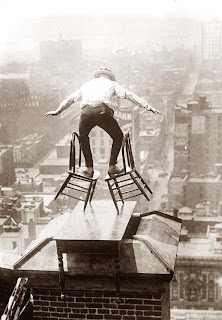
It’s all about balance.
The human body requires several sensory inputs in order to maintain balance. Visually, a balanced person requires references to tell them what their body is doing. To demonstrate this, try balancing on one foot, then close your eyes and try. When your brain is missing the visual references it constantly tries to rebalance its self and it becomes very difficult to stay balanced.
The brain also requires input from the inner ear.
(When you spin in circles and get dizzy, it’s because the fluid in your inner ear is still moving even when your body is stopped. All of a sudden, the information that your eyes and your inner ear send to your brain don’t agree, causing the dizzy feeling.)
Skating is a series of one-foot glides. You stride with one foot and glide on the other. Then you recover; putting that stride foot back down. Switch feet and repeat. It’s a controlled movement. Without balance, that recovery step resembles stomping on a bug; the foot crashes back down to the ice, speed is lost and all your weight is now on that foot. You’re forced to transfer your weight again just to take a good stride with the other foot. This is tiring, inefficient, and it looks incredibly awkward. Throw in opposing players trying to knock you off the puck and falling will become a common occurrence.
Balance comes with repetition; the more you get used to balancing yourself on one foot, the easier it gets. Stand on one foot when you’re watching TV, playing Wii, in the kitchen cooking or standing in line at the grocery store. Try bending your knees more. Try hopping in place. Try twisting your body. Lean forward. Purposely unbalance yourself and regain that balance. Toss a ball from your left hand to your right hand or toss the ball back and forth to a friend, all the while maintaining your balance on one foot. Soon, you’ll find that doing things on that 1/8th inch piece of steel gets a little easier.
Work on your balance while stationary, gradually working towards balancing while in motion. Then work at placing your foot down in a controlled motion. Over time, your balance will come and so will your stride.
So my question is: if you can’t stand on one foot when you’re in bare feet, how do you expect to be able to do the same on that thin piece of metal?
It’s all about balance.
In biomechanics, balance is an ability to maintain the center of gravity [remember that term?] of a body within the base of support with minimal postural
sway.
The human body requires several sensory inputs in order to maintain balance. Visually, a balanced person requires references to tell them what their body is doing. To demonstrate this, try balancing on one foot, then close your eyes and try. When your brain is missing the visual references it constantly tries to rebalance its self and it becomes very difficult to stay balanced.
The brain also requires input from the inner ear.
The inner ear is responsible for the sensations of balance and motion. It is made up of fluids and detection cells and sends information to the brain about the attitude, rotation, and linear motion of the head.
(When you spin in circles and get dizzy, it’s because the fluid in your inner ear is still moving even when your body is stopped. All of a sudden, the information that your eyes and your inner ear send to your brain don’t agree, causing the dizzy feeling.)
Skating is a series of one-foot glides. You stride with one foot and glide on the other. Then you recover; putting that stride foot back down. Switch feet and repeat. It’s a controlled movement. Without balance, that recovery step resembles stomping on a bug; the foot crashes back down to the ice, speed is lost and all your weight is now on that foot. You’re forced to transfer your weight again just to take a good stride with the other foot. This is tiring, inefficient, and it looks incredibly awkward. Throw in opposing players trying to knock you off the puck and falling will become a common occurrence.
Balance comes with repetition; the more you get used to balancing yourself on one foot, the easier it gets. Stand on one foot when you’re watching TV, playing Wii, in the kitchen cooking or standing in line at the grocery store. Try bending your knees more. Try hopping in place. Try twisting your body. Lean forward. Purposely unbalance yourself and regain that balance. Toss a ball from your left hand to your right hand or toss the ball back and forth to a friend, all the while maintaining your balance on one foot. Soon, you’ll find that doing things on that 1/8th inch piece of steel gets a little easier.
Work on your balance while stationary, gradually working towards balancing while in motion. Then work at placing your foot down in a controlled motion. Over time, your balance will come and so will your stride.
Wednesday, December 17, 2008
Center of Gravity
Everything has what is called a Center of Gravity, or Center of Mass. In simple terms, it’s the imaginary point around which something’s weight is perfectly balanced. It’s also the p oint that gravity acts through, and gravity always acts downward. In people, gravity acts through a point that is close to your belly button; your Center of Gravity.
I’ve enlisted the help of our friend Don to demonstrate what’s really happening. (Thanks Don!) The red dot is his Center of Gravity and the arrow is gravity.
When Don is standing on two feet (Picture #1), his Center of Gravity is between his legs, half the distance between his skates. He is balanced.
 When Don stands on only 1 foot (Picture #2), his center of gravity moves. Now that Don has only one skate to stand on, gravity must act straight through his skate blade. In this case, Don’s Center of Gravity is outside of his skate blade. Unless Don adjusts himself, he’ll fall over.

In Picture #3, Don has adjusted his Center of Gravity so that it is directly above his skate. Don is now balanced.
We’ll talk about balance soon.
 oint that gravity acts through, and gravity always acts downward. In people, gravity acts through a point that is close to your belly button; your Center of Gravity.
 I’ve enlisted the help of our friend Don to demonstrate what’s really happening. (Thanks Don!) The red dot is his Center of Gravity and the arrow is gravity.
When Don is standing on two feet (Picture #1), his Center of Gravity is between his legs, half the distance between his skates. He is balanced.

 When Don stands on only 1 foot (Picture #2), his center of gravity moves. Now that Don has only one skate to stand on, gravity must act straight through his skate blade. In this case, Don’s Center of Gravity is outside of his skate blade. Unless Don adjusts himself, he’ll fall over.
In Picture #3, Don has adjusted his Center of Gravity so that it is directly above his skate. Don is now balanced.
We’ll talk about balance soon.
Tuesday, December 16, 2008
The Blue Line Rule

OK, so everyone has been on teams that have had trouble clearing the zone and/or breaking in. This rule stems from that scenario. However it does not solve that problem, but does alleviate it just a bit.
The rule is: When you are about five (5) feet from your defensive blue line, dump the puck out of the zone and across the blue line; when breaking into the zone and five (5) feet from the offensive blue line, dump the puck in and go get it.
Now there are some variations to this, and it mostly applies to when you have pressure, more so when in the defensive zone. Use the boards to get the puck out and at least buy some time to re-organize on defense. The boards are a part of the rink for a reason, so lets go ahead and use them. When you get pressure trying to exit the zone, bounce it off the boards and around the opposing team and step around them to retrieve it.
Now when breaking into the zone, this same method applies. If you receive a good amount of pressure trying to get across their blue line, use the boards and dump it in and go get it. This is better than trying to make the cute fancy move at the blue line, that you may or may not be able to do, that usually ends up in a turnover. Even if you do not get the puck back, the other team has to go nearly the whole length of the ice rather than just two thirds of it when the puck gets turned over at the blue line.
Of course there are pros and cons to both of these, but the pros out-weight the cons. When exiting the zone, they will have to wait for everyone to get on-side before re-entering, giving you time to organize again and get set up, or make a change, even if it is a few people. When breaking into the zone, you don't risk a turnover at their blue line. With both, you will have a less likelihood of having your three forwards leaving the zone, turn the puck over, and have a 3-on-2 going back at your end.
So remember, five (5) feet, and get the puck across whichever blue line you are at. It will save you in some tough spots.
The Heart of Hockey
Hockey players are portrayed in the media as being violent and raw. The only time mainstream America hears about hockey is when someone does something aweful on the ice. It's quite unfair.
This story about the Chicago Blackhawks is one of hundreds of stories that arean't usually told but need to be.
I say it has nothing to do with being from Canada and everything to do with hockey. And with shaking your opponents' hands after you've battled them for 3 periods.
This story about the Chicago Blackhawks is one of hundreds of stories that arean't usually told but need to be.
"I've played for different teams in juniors and the pros," said the 26-year-old Sharp, from the Ontario hockey hotbed of Thunder Bay. "And you walk into every locker room and you become brothers. Maybe it's rare in pro sports, but it's not rare in hockey, I don't think. We're all in this together. It goes back to growing up in hockey. My older brother played, I played, and my parents made huge sacrifices to drive us everywhere we had to go. Everyone in this game knows how much family means."
I say it has nothing to do with being from Canada and everything to do with hockey. And with shaking your opponents' hands after you've battled them for 3 periods.
Monday, December 15, 2008
The Face Rule
I tend to develop 'rules' based on things I see out on the ice. Many of these rules build my hockey philosophy and I'm always adding new rules. Some rules are more important than others. I played in an adult-league game last night and something I saw supported one of those rules.
The rule is: If you insist on wearing only a half shield or no shield to protect your face and you flinch and cover your face every time the puck leaves the ice in your general vicinity, you should be wearing a full cage.
Half shields look cool, especially with the variety of tints and colors they now come in. But if you're wearing anything less than a full shield because it looks cool, you've missed the point.
Steve and I coach in half shields and Steve still plays in one. We used to coach in baseball caps! I switched back to a full cage after 5 stitches to the chin and I know Steve has been bloodied on at least one occasion. But in all the games we've played together, I've never seen Steve flinch because of a puck or a stick coming too close (and I'm pretty sure I never did). We still block shots and go into the corners with partial protection because we've learned how to tuck our chins and avoid damage.
This recent post by Third Man In further supports my theory (Warning: the picture is pretty ugly...no blood, but still bad).
Wear what you want to wear but if you're afraid of getting hurt, wear more protection.
The rule is: If you insist on wearing only a half shield or no shield to protect your face and you flinch and cover your face every time the puck leaves the ice in your general vicinity, you should be wearing a full cage.
Half shields look cool, especially with the variety of tints and colors they now come in. But if you're wearing anything less than a full shield because it looks cool, you've missed the point.
Steve and I coach in half shields and Steve still plays in one. We used to coach in baseball caps! I switched back to a full cage after 5 stitches to the chin and I know Steve has been bloodied on at least one occasion. But in all the games we've played together, I've never seen Steve flinch because of a puck or a stick coming too close (and I'm pretty sure I never did). We still block shots and go into the corners with partial protection because we've learned how to tuck our chins and avoid damage.
This recent post by Third Man In further supports my theory (Warning: the picture is pretty ugly...no blood, but still bad).

Wear what you want to wear but if you're afraid of getting hurt, wear more protection.
Subscribe to:
Posts (Atom)