Friday, February 13, 2009

Biomechanics

Biomechanics is the application of mechanical principles to living organisms.

I consider myself a bit of a geek when it comes to mechanical systems. I love figuring out how things work and why and I tend to apply that inquisitive part of me in analyzing all things sports related. I try to break down simple motions into even simpler motions to answer questions about the motion.

In hockey, I'm constantly deconstructing the strides, shots, turns and passes of myself and others in order to correct flaws or simply get better. As I haven't been able to shoot a puck over 100 mph, clearly I have some more work to do.

I recently read an article about a baseball pitcher, 2008 Cy Young Award winner Tim Lincecum. Lincecum, you see is only 5'10" tall and weighs only 175 pounds, but is somehow able to throw a baseball 97 mph. It's not a fluke though. Lincecum has a unique delivery; he drives hard off his back leg and severely torques his body, allowing him to accelerate his arm without putting stress on his shoulder.

The article gets pretty deep into the study of sports biomechanics and, while it deals entirely with baseball pitchers, much of the science can be directly related to hockey. It's a fascinating read...I highly recommend it.

Then again, I geek out over this stuff.

Snapper

I pulled the following description from Wikipedia:
The snap shot is accomplished with a quick snap of the wrists while the puck rests in place. The difference between a snap shot and a wrist shot is that the hockey blade is accelerated towards the puck from a small distance behind it. This allows the player to flex the shaft on the ice and strike the puck at speed -- although not to the degree of a full slap shot…The stick is usually not lifted higher than the knee during the shot.

I tend to agree with everything about that statement, except the bold portion. In recent years, the term “half slap shot” has referred to a shot that resembles a slap shot, but with only half the wind-up (or the knee-high wind-up).

A snap shot is a far different animal. I like to use a face off dot as the representation of my wind-up space. With the puck in the center of the dot, my stick blade will stay within the diameter of the face-off dot and will get no higher than 4 or 5 inches from the ice.

You may be asking yourself “how do you generate any speed with that small a wind-up?” The answer is simpler than it sounds. 1) Speed is generated through the hips and lower torso. My weight is transferred from my back leg, driving my hip forward. Essentially, my lower body is rotating while my upper body is still. This generated torque between my lower body and torso. My upper body wants to rotate to catch up to my lower body, and accelerates to do so. With very little input (so far!) from my arms, my hands are already moving quickly. 2) I lower my shoulder and drive the toe of the stick into the ice. As stiff as they seem, all components of a stick flex when weight is applied. The stick blade flexes and flattens out for a split-second when it makes contact with the ice. The shaft of the stick also flexes, albeit not as severely as a slap shot will. The shaft and blade quickly snap back into position and helps accelerate the puck even more. The snap shot finishes with the same motion of a wrist shot; a snap of the wrists and a hard pull with the top hand, which turns the stick blade over.

A good, hard snap shot is a very hard shot for a goalie to pick up. It has no wind up, like with a wrist shot or slap shot, and it is as accurate as a wrist shot while being only slightly slower than a slap shot.

Wednesday, February 11, 2009

Big Heart Ted

Ever since Ted Leonsis, owner of the Washington Capitals, bought the team, he's been a passionate voice for hockey in the DC area. I genuinely believe that he loves hockey and his team and wants it to succeed.

That said, the man is also a terrific human being, as seen in this first-hand account by Tarik El-Bashir of the Washington Post.

If you see him walking the halls the next time you take in a Caps game, shake his hand for this rather than for bringing back good hockey to the area.

Monday, February 9, 2009

Constructive Criticism

I was sent this article by a friend and fellow hockey player. The article is entitled "Unskilled and Unaware of It: How Difficulties in Recognizing One's Own Incompetence Lead to Inflated Self-Assessments" and it is an incredibly interesting read. Here's a quick excerpt from the abstract:

People tend to hold overly favorable views of their abilities in many social and intellectual domains. The authors suggest that this overestimation occurs, in part, because people who are unskilled in these domains suffer a dual burden: Not only do these people reach erroneous conclusions and make unfortunate choices, but their incompetence robs them of the metacognitive ability to realize it. Across 4 studies, the authors found that participants scoring in the bottom quartile on tests of humor, grammar, and logic grossly overestimated their test performance and ability.


In coaching, we're constantly finding ourselves faced with the opportunity to provide constructive criticism to a student in order to increase the player's skill set. Often, we see that advice abandoned because the player 'already knows how to' perform the particular skill.

Constructive criticism can come in many forms, from a simple 'try it this way' to a red 'X' on a test. Both provide you with feedback on your actions or knowledge of a subject and you can learn a lot from both, IF you're open to the criticism.

A 'wrong' often teaches you more than a 'right', but you first need to be able to acknowledge the wrong and ask 'why?' and 'how do I get to right?' That's where learning truly begins.

Thursday, January 15, 2009

Fisticuffs

I just thought I'd link to an interesting article on fighting. This one particular quote from Wendel Clark, former captain of the Toronto Maple Leafs, pretty much sums up my opinion on the issue:

"Look, I'm not going to say I'm against it. I played that way. I think it's part of the game at the pro level. What I am concerned about is the amount of fighting going on in minor hockey. There are only two levels where it is allowed and there are specific rules for it - the pros and junior. Yet at the bantam and midget levels, not just at AAA but AA and A too, the amount of fights are going up. It is not part of the game there. There are no rules. You fight, you're kicked out. Yet it's increasing. Who is condoning this for our kids? Coaches, parents, whoever it is, it has to stop.

Fighting in the pros is one thing. They are adults. They are professionals. They are doing it for a living. But kids? I know in my case, I didn't have my first fight until junior. No one starts out wanting to be a fighter. They all want to be finesse guys, the next Sidney Crosby. Like I said, there is room for it in the pros in my opinion, but what's going on with the kids concerned me.”

Thursday, January 8, 2009

What's in a Name?

We've gotten a lot of feedback about the blog so far, but the most commonly asked question is 'What's with the name? It's bad.' Is it? Tell us what you think!


Wednesday, January 7, 2009

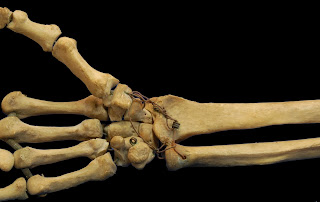
Biomechanics of the Wrist

Every joint in the human body is designed to flex in a certain way based on the structure of bones, tendons, ligaments and cartilage in the joint. Knees and elbows are designed to flex in one particular direction. The joints of hips and shoulders provide nearly full freedom of movement in all directions. The wrists and ankles allow for motions unique to the joints’ needs. Today we’ll talk about the wrist as it relates to hockey.


The wrist is a Condyloid joint and is constructed from several small bones that are surrounded by a capsule and strengthened by ligaments. This construction allows for three degrees of movement (Up and down, left and right, and axial rotation) of the joint.

Holding your arm out in front of you, palm down, rotate your hand as far as you can in one direction and the other without moving your shoulder. You should notice that rotation in one direction allows your palm to face up but does not allow for much more rotation past that (about 180 degrees of motion). In the other direction, your hand can move to a sideways position (about 90 degrees) before stopping. Attempting to rotate your wrist past these limits is not a natural motion and can end up causing some pain. These ‘hard stops’ define the limitations of the joint, or the ‘freedom of movement’.

In hockey, whenever you stick handle, pass, receive a pass or shoot a puck, you are rotating your wrists; sometimes slightly, sometimes severely and usually quite quickly. Holding your stick in the correct position allows your wrists to rotate freely without ever hitting a ‘hard stop’, decreasing the chance of causing wrist pain or injury and improving the accuracy and speed of the shot, pass, or stick handing move.

We’ll talk about the proper way to hold your stick in a bit. Just remember to stay within your body’s range of motion and you’ll find the proper technique based on how it feels to your body.